
By Corina Godoy, Seed Collections Manager, Mojave Desert Seed Bank
Collections Manager Corina Godoy has watched the Mojave Desert Seed Bank grow in real time, from a small effort without permanent staff to a science-forward program caring for millions of seeds. What can be learned from other seed banks at this stage in our development? Corina traveled to Oregon on a special research trip to find out.
Day 1
I forget how different summers are outside of the Mojave Desert. Just a quick plane ride and the radio will tell you the hottest day of the week is in the low 90's. I was headed north to learn from other seed banks and plant conservation organizations how to further strengthen MDLT’s seed conservation program.
From Joshua Tree, I traveled to Corvallis, Oregon to meet with Alexis Larsen, the Plant Materials Program Director for the Institute of Applied Ecology (IAE), a nonprofit organization with a robust plant materials program that increases the availability of seeds for habitat management and restoration. Alexis kindly showed me how they bulk, dry, process, and store their seeds at a larger scale.
The first stop was a temperature-controlled greenhouse where they dry the seed they harvest from their farm. Some of the collections were laid out to dry in kiddie pools to prevent pests from climbing in and eating the seeds. Other pools had a mesh netting placed over the drying seed material to capture the seed that dehiscent fruits spit out as they ripen.
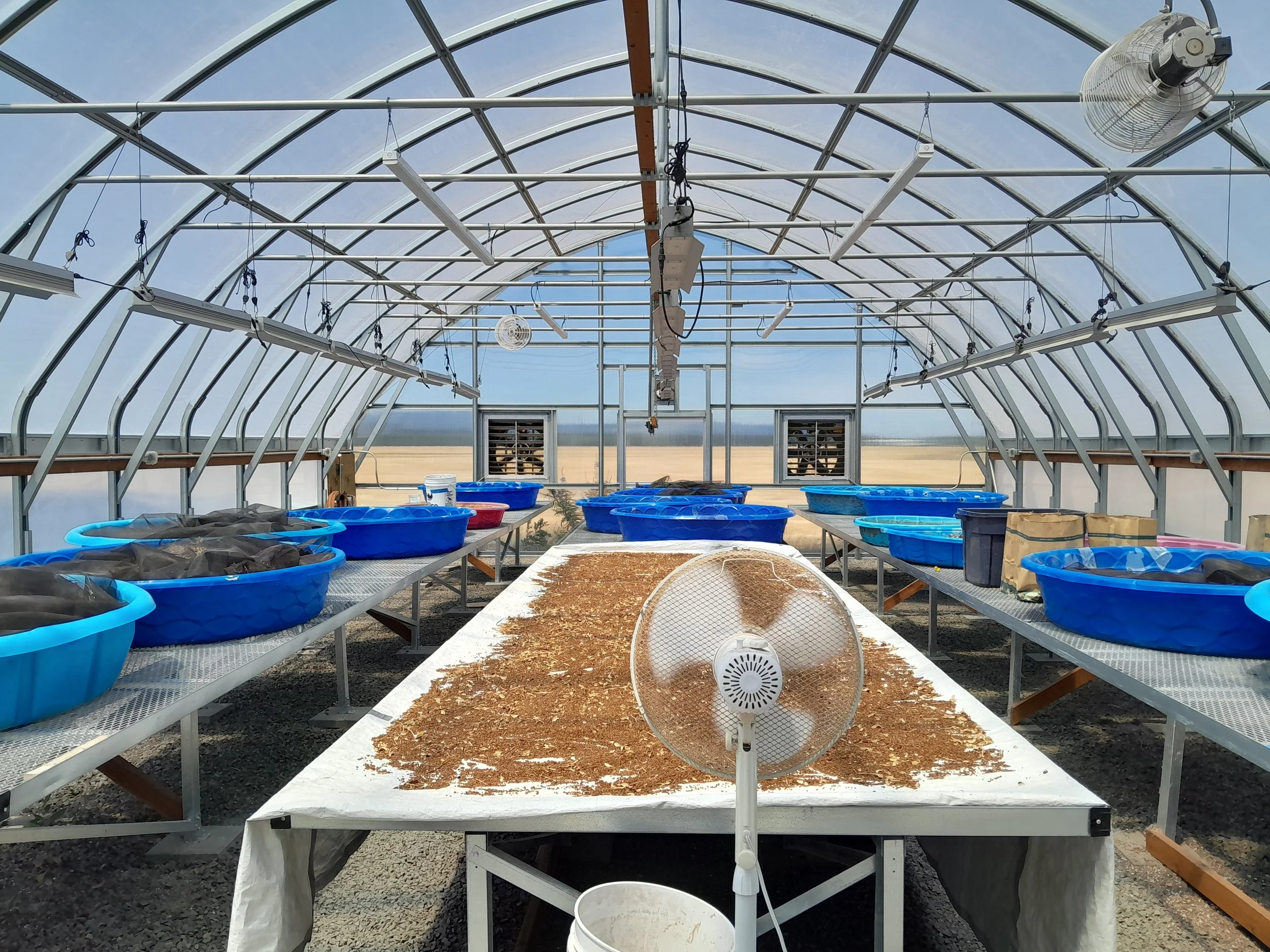
The seed drying greenhouse at the Institute of Applied Ecology.
Their greenhouse was beautiful, and as I looked around, I saw familiar-looking tools and modified equipment.
We looked at their processing area next, where seeds are cleaned and prepared for storage. Around the room was what I could only describe as the "older brothers" to our machines back home. There was a machine that was so big you needed to get on a ladder to feed it. This area included a drying room and a walk-in frozen storage unit as well. Learning about the workflow, challenges, and set-up of this seed bank will come in handy in the near future when we expand our own processing area.
Thinking of what the future holds made me reflect and realize how far MDLT’s seed program has come. Prior to receiving funding from the Wildlife Conservation Board, the seed bank wasn't staffed, and our collections were primarily made by volunteers and Nursery staff who would take a few hours on cool desert mornings to collect seeds from a local preserve. Now we have teams within our seed bank staff who spend days visiting our preserves, strategizing, and collecting seeds to store for the future. Who knows? Maybe a farming team is in our future, too.
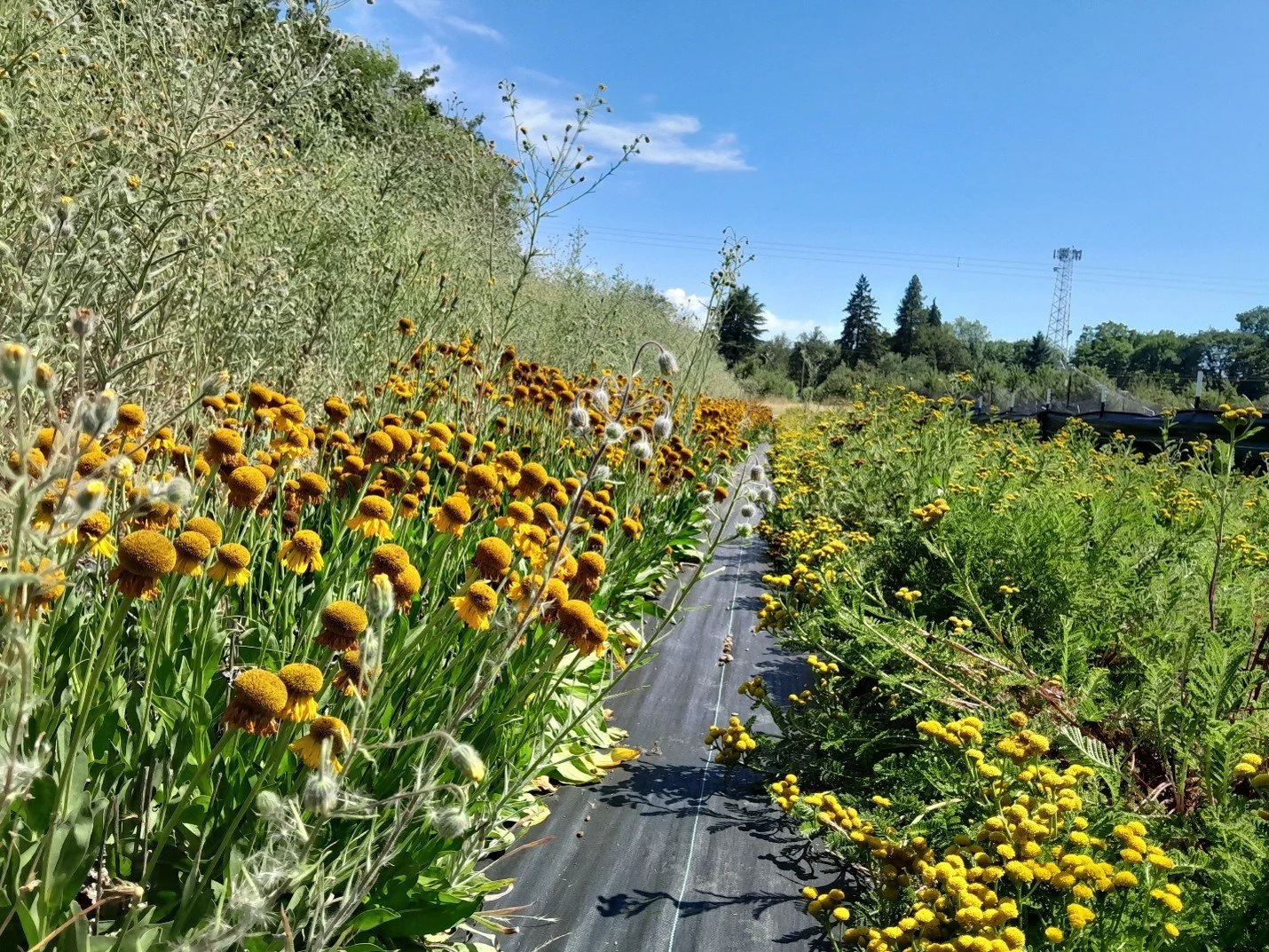
A portion of the farm at the Institute of Applied Ecology.
The IAE has a farm where they grow a variety of plant species that support the restoration work implemented by tribal entities, non-profit organizations, and state and federal agencies. The farmland belongs to Oregon State University and hosts a variety of research projects. These plots are large enough that a combine can be used to collect the seeds, although some species need to be harvested by hand with pruners or hand vacuums to minimize damage to seeds and collection of excess plant material. Seeing this framework in action will help us develop the future of the Mojave Desert Seed Bank as a larger restoration resource for our partners in desert conservation.
Day 2
I arrived at the Oregon State University Seed Lab, ready for a full day of training. The lab was busy with folk moving from one office to another, greeting each other, and beginning the day's work. Professor of Seed Science & Technology Dr. Elias G Sabry welcomed me, and we began our tour of the facilities. In the weeks before I arrived, we communicated about MDLT’s seed bank program and what our challenges were. As we walked through the facilities, I shared about projects MDLT participated in and work we wanted to pursue in the future.
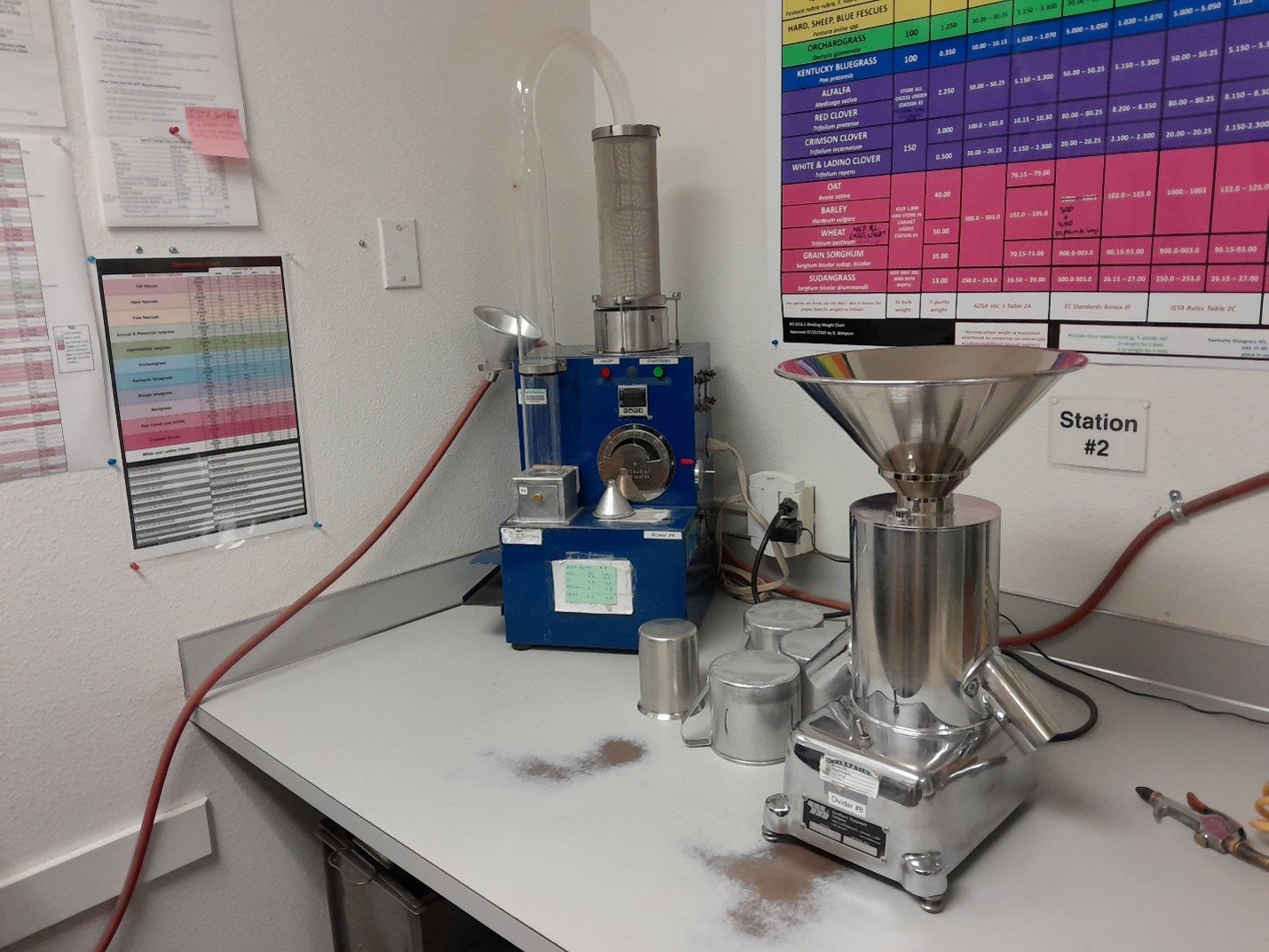
Seed cleaning machinery at the OSU seed lab.
One of the main objectives of this training was to improve how MDLT conducts our germination tests and how we maintain and monitor seed collections while they’re in cool storage. Back at HQ, we have one germination chamber about the size of a fridge. Here, there was a hallway of walk-in germination chambers with different temperature settings, most with stacks of germination tests on the shelves within. While some shelves sat empty, Dr. Sabry mentioned that their busy season was about to begin, and soon the shelves would be filled with tests from incoming seed lots.
One of the main takeaways for the day was the efficiency of using germination paper for germination tests. This trip really solidified that our testing processes would benefit from transitioning from agar to this method, which has much lower prep and maintenance needs.
I ended the day with multiple pages filled in my notebook and many questions answered, covering increasing and maintaining the quality of our seed collections and how to troubleshoot breaking dormancy for species that lack scientific literature to reference.
Day 3
The OSU seed lab acts as an international resource for testing seeds, largely for crops. Because of this, they offer a variety of tests that determine a seed collection’s purity (the proportion of seed to inert matter or seeds of other species), viability (the ability to germinate), vigor (the ability to germinate reliably and rapidly), and presence of disease. Analysts in the lab were busy working on prepping incoming seed samples for testing, methodically plating and adjusting seeds onto germination paper. Observing these new tests might lead to a side project for our team that can help us understand how the germination conditions of the same species may differ in other zones.
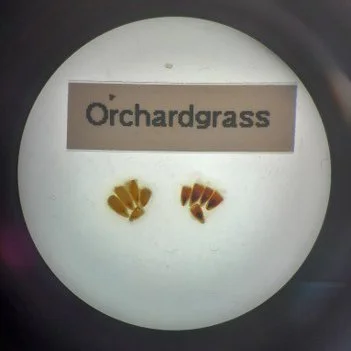
A tetrazolium test with non-viable seeds on the left and viable seeds with embryos on the right.
I had a chance to spend some time with Yea-Ching Wu, the Germination and Viability Supervisor at the OSU seed lab. It was helpful to analyze a tetrazolium test (a seed viability test that stains live tissues with a red dye) side by side with an expert and discuss the methodology that they use and the way they prevent errors in interpreting the results. Tetrazolium testing is still relatively new to MDLT’s lab processes and has already proven helpful in answering questions we have in our germination and propagation work.
I'm glad that I have a wealth of information to take back to our program, and it was reassuring to hear from experts that some species are just plain difficult to work with; either because of the small, fragile nature of their seeds, the appendages on the fruit that inconveniently stick to machines, or the inert material that becomes a similar weight and size to the seeds you are working on. For some of these difficult species, I secretly hoped that there was a magic machine that could clean them perfectly so we wouldn't have to clean these seeds by hand. Alas, hand cleaning it is.
Day 4
The last stop of the trip was to the Rae Selling Berry Seed Bank, a conservation seed bank that lives within the Portland State University campus. Their work primarily focuses on managing collections of rare, threatened, and endangered plants native to the Pacific northwest region, while also supporting a wide range of collections from throughout the western United States. They also contribute to creating accessibility to common native plant materials for the public and for ecological restoration projects.
I met with Riley Forreider, Interim Director and Chief Curator; Roxy Olsson, Propagation Program Manager; and Milo Greenway, laboratory technician intern, to learn more about their seed collection management and general seed bank operations. They kindly took me through their workflow which includes collecting, processing, storing, and managing seed collections in long term freezer storage. This work is done meticulously by hand and machinery, to protect the collections as they move through each step in the process. Their lab, germination chamber, and greenhouse were spread throughout the campus, which I was selfishly very pleased to tour.
Visiting the folks at Rae Selling Berry seed bank helped me identify areas where we could improve our germination testing and storage methods. I anticipate making some changes to our processes when I get back, like reassessing our standard temperatures for our germination chamber.
I was also reminded how important it is to actively share what we’re learning. Roxy shared how the propagation information they collect from their ongoing projects is logged and will ultimately inform a larger scale restoration project in Oregon. This information would not only stay within the project but also be shared online for the public to access and inform similar restoration projects.
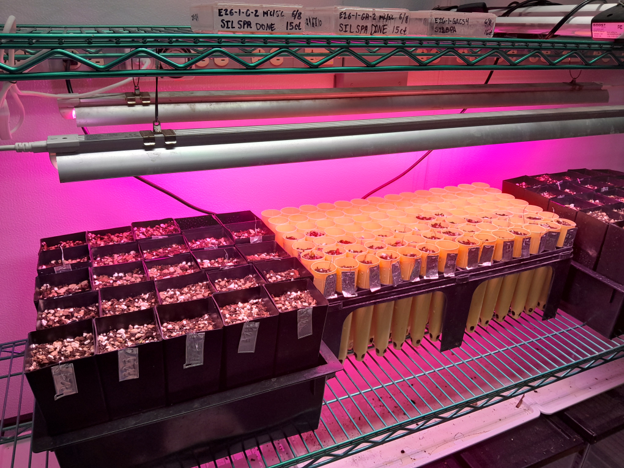
A restoration project in progress at the Rae Selling Berry Seed Bank.
Before I headed out, I had the opportunity to share a bit about the work that we do, changes we’ve made to our data collection, what our volunteer engagement looks like, partnerships we have, projects we’re a part of, and things we learned the hard way that made our life easier.
I enjoyed my time so much, I almost forgot I had a flight to catch.
It was great to learn about their program and hear about what their future looks like. Everyone does their seed work a little differently because of their mission, funding, or capacity. Somehow, we all end up at the same place by inventing crazy things to meet our specific needs, but we’re all doing great work and leveraging what we have.
For me, this was a very reassuring trip. While I often found myself wishing we had "this" or "that", I saw that we're on the right track. There are improvements we can make in our lab and processing operations, but we're more than on our way.
All it comes down to is what makes sense for us to do with the seed we're working with, the area we serve, and the resources we have available.
Sign up for our newsletter to follow more plant conservation news.
This work is made possible thanks to generous support from the California Wildlife Conservation Board.