
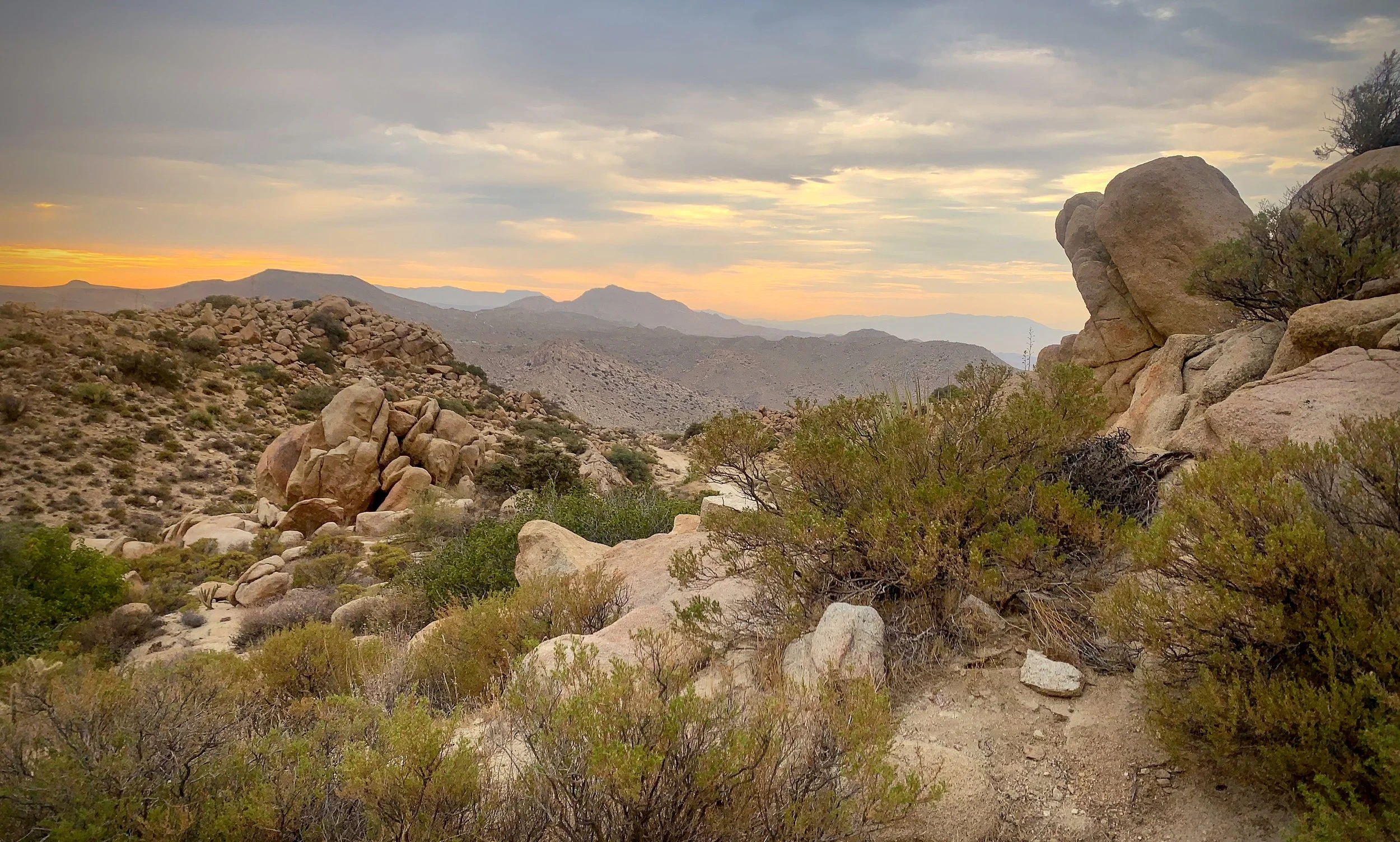
View of the Jacumba Wilderness. Photo: Josh Jackson
By Josh Jackson, Chief Storyteller
I arrived at an empty gravel parking lot in the late afternoon. It was July 2021. My phone registered 87 degrees, the same number my body registered as I stepped from the air-conditioned car. I checked my online map, filled my backpack with binoculars, three liters of water, and a few granola bars, and started walking up a narrow Jeep dirt road.
A mile later, a thin, rust-colored sign marked the entrance to the place I had come to explore: the Jacumba Wilderness. Managed by the Bureau of Land Management, the 31,357-acre Wilderness is sandwiched between Interstate 8 and the U.S.–Mexico border. I had driven down after learning that construction of a 30-foot border wall along the southern edge of the wilderness had begun.
In vertical black letters, the sign read:
W
I
L
D
E
R
N
E
S
S
The word was worth pausing on.
Thanks to the Wilderness Act of 1964, I was now entering the highest standard of public land protection in the nation. Led by Howard Zahniser, passage of the Act took an astonishing eight years of advocacy, sixty-six drafts, eighteen congressional hearings, and more than sixteen thousand pages of testimony before Congress finally approved the legislation.
The law was designed to preserve places "where the earth and its community of life are untrammeled by man." It protects landscapes from new roads, development, extraction, and mechanized travel—areas where plants and animals take priority over profits and human ambitions. Not even bicycles are permitted.
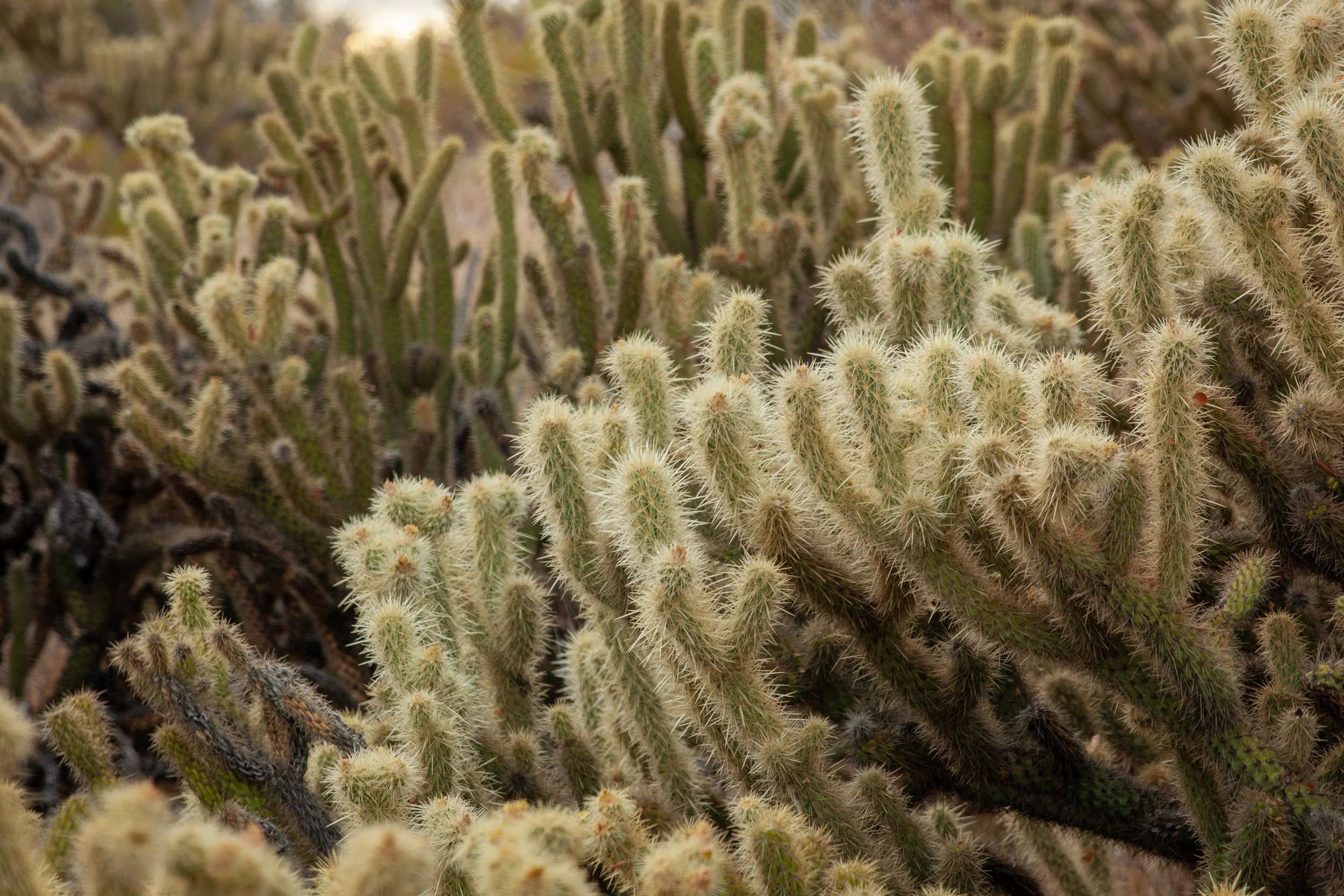
A close-up of cholla in the Jacumba Wilderness. Photo: Josh Jackson
Which is what made the decision to build a border wall through the wilderness so unsettling.
Walls require bulldozers. Walls require roads. Walls require infrastructure. Walls represent everything the Wilderness Act was written to prevent.
The ecological consequences of building the border wall here are profound. By cutting across landscapes that wildlife has traversed for thousands of years, border walls fragment habitat, isolate populations, and sever ancient migration routes.
Here in the Jacumbas, mountain lions, mule deer, bobcats, and a host of other mammals move freely across the international border in search of food, water, mates, and seasonal habitat. Perhaps no species depends more on that connectivity than the endangered Peninsular bighorn sheep. It was those sheep, more than anything else, that had brought me here.
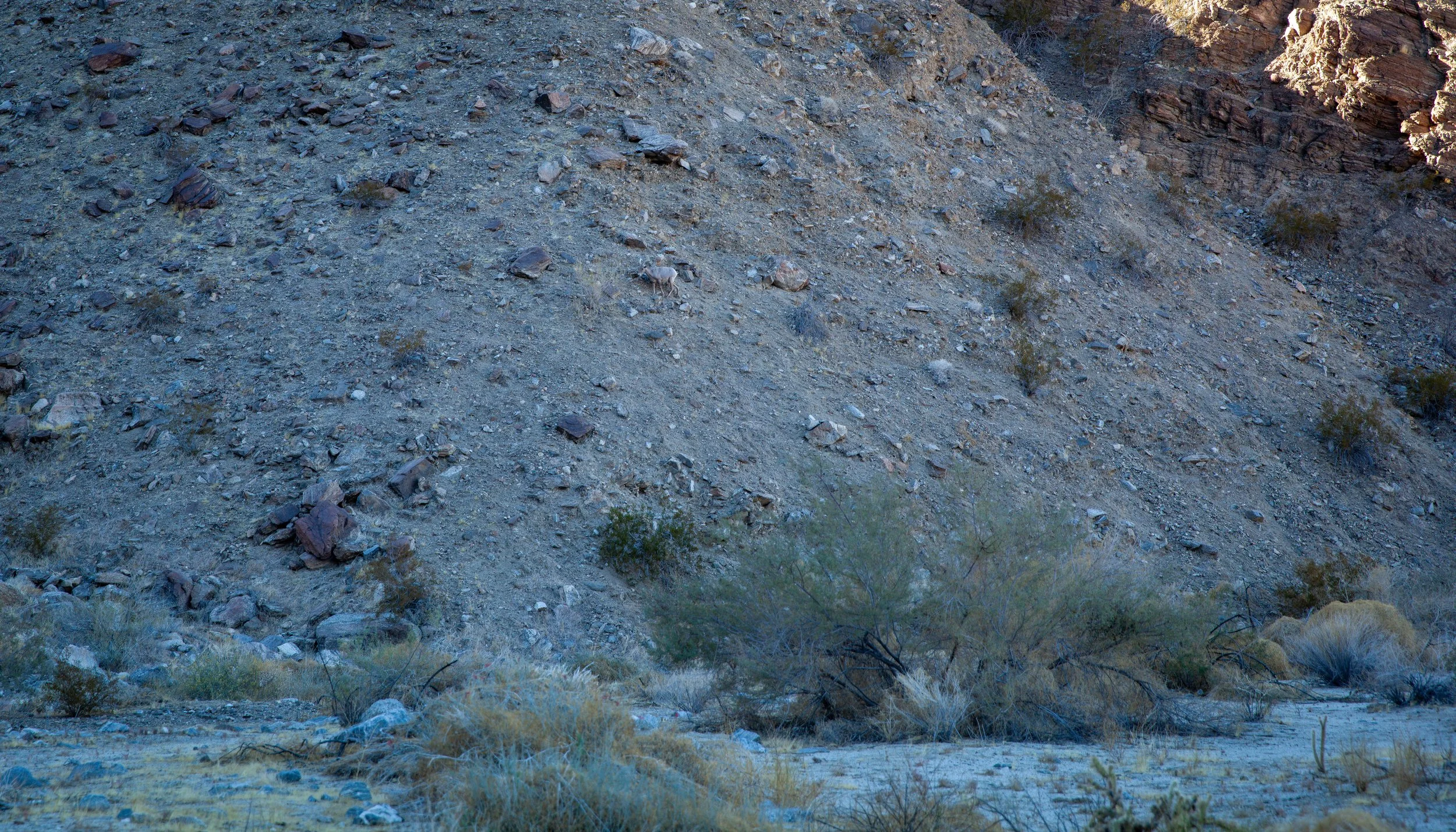
Catching a glimpse of bighorn can be difficult. This sheep was seen in the Santa Rosa Mountains. Photo: Josh Jackson
I left the Jeep road behind and followed a faint footpath into the wilderness. The trail descended through a valley where jointfir, saltbush, and buckwheat filled the spaces between enormous granite boulders. It looked as though the mountains had been built from giant blocks of stone and then, over countless millennia, gently taken apart, leaving boulders scattered across the landscape like the pieces of an unfinished puzzle.
Temperatures fell in tandem with the setting sun as I forged my own path south, wandering through washes and ascending rocky outcrops until I was standing atop an unnamed summit just shy of 4,000 feet. Granite domes unfolded in every direction, giving way to broad valleys where desert scrub gradually yielded to open woodlands of singleleaf pinyon and Muller's oak, each blending naturally into the next without regard for the international boundary in the distance. Mexico lay less than half a mile to the south. From my perch, the landscape still flowed uninterrupted across the border. It was impossible to imagine that such a place could ever be divided.
A changing desert
As darkness began settling over the landscape, I glassed the cliffs and ridgelines for movement. Peninsular bighorns are remarkably difficult to see, their tan coats disappearing against weathered granite as they spend much of the day resting among cliffs where even experienced observers can walk past without ever noticing them.
The steep slopes surrounding me weren't obstacles. They were refuge. For generations, these mountains have offered the sheep protection from predators, cooler temperatures during the heat of summer, and a network of travel routes between seasonal sources of food and water. Each year, ewes give birth on the U.S. side of the border before leading their lambs south into the mountains of northern Baja, where more reliable water carries the herd through the summer. In following their mothers, each new lamb learns the routes that have sustained the population for centuries.
Five years have passed since that July afternoon. Construction of the 30-foot border wall is continuing, and the remaining gaps have been draped with coils of concertina wire until the barrier is completed. Today, that seasonal movement is no longer possible. Earlier this summer, a Peninsular bighorn ram was found dead after becoming entangled in the wire—the very outcome wildlife biologists had warned about.
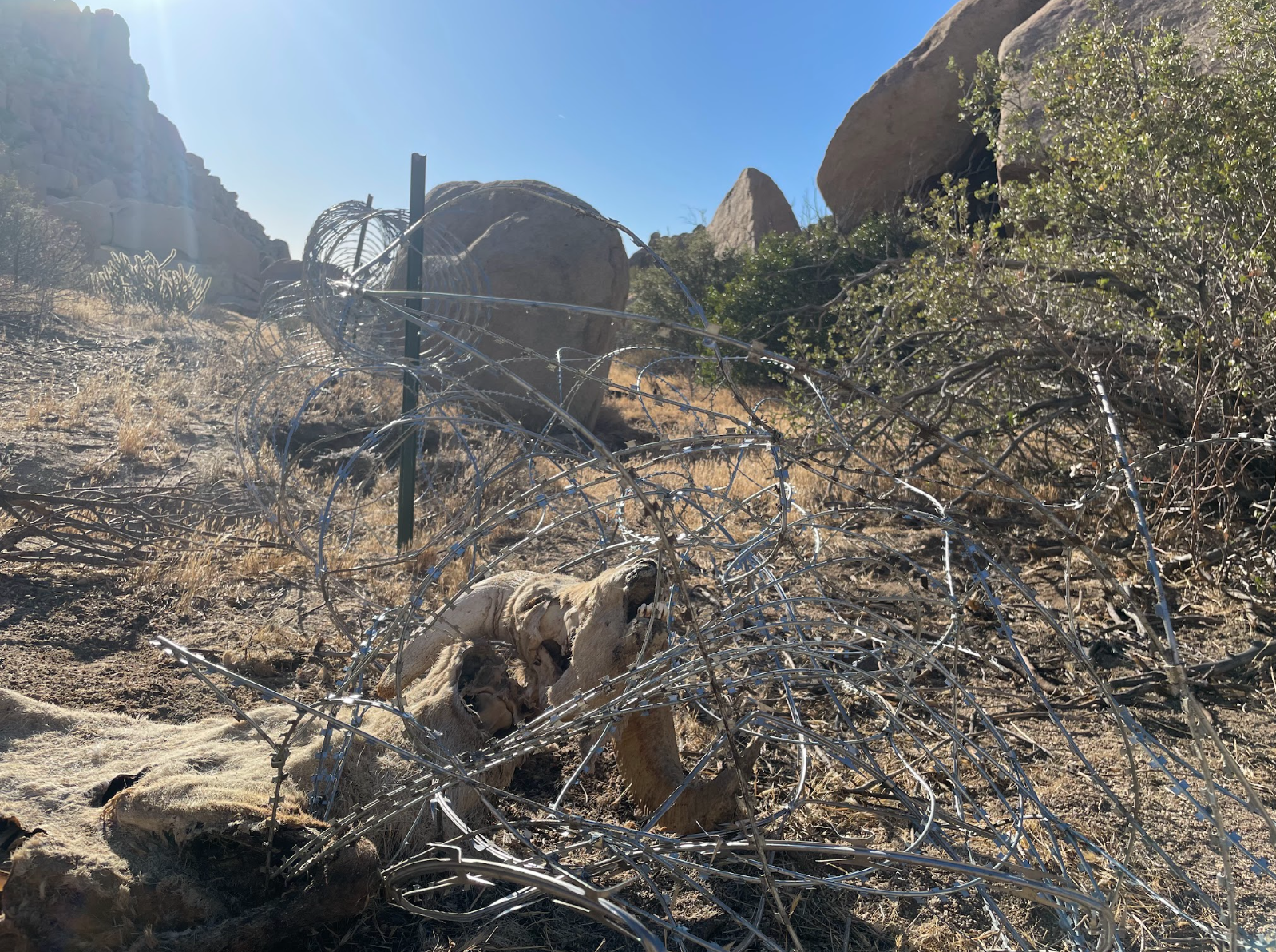
Photo: Wildlands Network
For thousands of years, the sheep adapted to a changing desert by moving across it. When their numbers fell to the brink thirty years ago, we adapted too. We protected habitat that would safeguard lambing grounds and keep populations connected across the landscape, helping a dwindling population rebound. Now the landscape has changed again. The adaptation belongs to us once more—not simply protecting the desert they have left, but reimagining conservation for a population whose way of life has been fundamentally changed.
Take action today. Contact your representative to ask them to push for protective measures to ensure that these majestic and endangered animals have a way to access water and forage in the Jacumba Wilderness.
Key facts
1. The Peninsular bighorn sheep (Ovis canadensis nelsoni) was federally listed as endangered on March 18, 1998.
2. Geographic isolation by valleys, urban development, and highways has made them a genetically distinct population of desert bighorn sheep.
3. They live in matrilineal family groups, with related females forming lifelong ewe groups while males move between them during the breeding season.
4. Although smaller than their northern relatives, their horns are nearly the same size—making them disproportionately large for their bodies.
5. They depend on moderate slopes for feeding and movement and cliffs steeper than about 30 degrees for escaping predators and giving birth.
Did you know?
Desert bighorn sheep have a role to play in maintaining a healthy ecosystem. Their presence is an indicator of a functioning desert ecosystem. As herbivores, their feeding habits of grasses, bushes and leaves ensure plant diversity. Their feces enriches desert soils through nutrient cycling.
They are a food source for apex predators such as mountain lions, coyotes and eagles. As an apex herbivore, desert bighorn sheep directly influence vegetation structure. If this population were to become extinct, this would result in unmonitored overgrowth of vegetation. This could result in increased catastrophic wildfire events that could affect the entire Jacumba Wilderness area.
Desert ecosystems play a critical role in sequestering carbon. As ecosystems, particularly plants, are affected by the loss of an important herbivore, the ecosystem’s ability to effectively combat climate change becomes limited.